The Nine Dimensions of Wellness, Explained
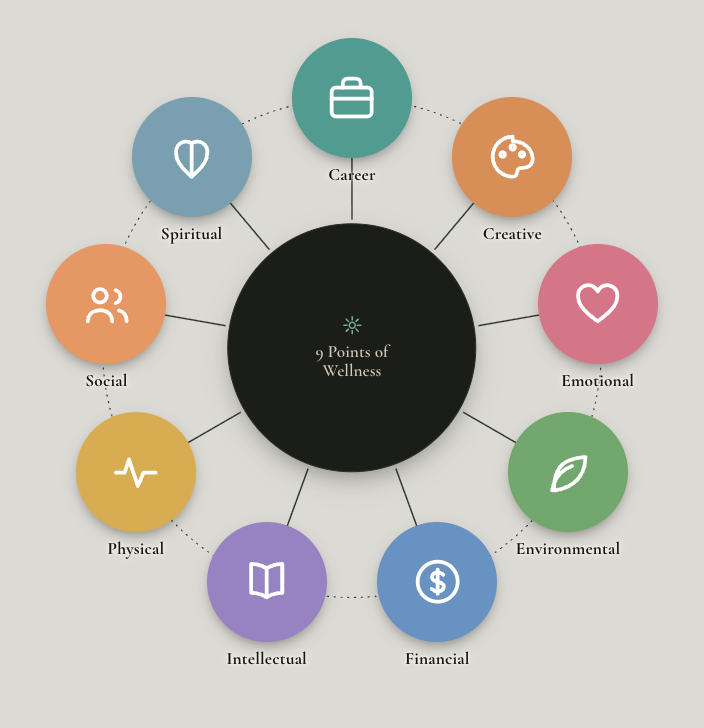
Ask someone how they are doing and you will usually get one word back. Fine. Busy. Tired. Good, mostly.
That one word is doing an impossible job. It averages your work, your bank account, your body, your relationships, your sleep, your sense of purpose, and the state of your kitchen counter into a single score, then rounds it off. No wonder it rarely tells you anything useful. "I'm fine" can hide a career that is quietly draining you. "I'm a mess" can be one bad area spilling over onto eight that are holding up surprisingly well.
The nine dimensions of wellness are a way to stop averaging. They split a life into nine distinct areas (career, creative, emotional, environmental, financial, intellectual, physical, social, and spiritual) so you can look at each one on its own, see which ones are strong, and notice the one that has been neglected while you were busy with the others.
This guide walks through all nine: what each dimension means, what it looks like when it is working, the signs it needs attention, and one small first step for each. At the end you will find a free way to score yourself across all nine.
Where the nine dimensions come from
The idea that wellness has more than one dimension is about fifty years old. In 1976, Dr. Bill Hettler, co-founder of the National Wellness Institute, introduced a six-dimension model: emotional, occupational, physical, social, intellectual, and spiritual. His point was simple and, at the time, fairly new: being well is more than not being sick.
In 2006, Margaret Swarbrick expanded the model to eight dimensions by adding environmental and financial wellness. The U.S. Substance Abuse and Mental Health Services Administration (SAMHSA) adopted that eight-dimension version, and it is the one you will see on most wellness wheels today.
Many universities, including Ohio State, add a ninth: creative wellness. That nine-dimension model is the one My Wellness Framework is built on. (You will sometimes see "occupational" where we say "career." It is the same dimension.)
Think of these models as a map. They show you where you stand and which areas you have been ignoring, and nobody else is grading you on them.
Why split your life into nine areas?
"I need to get my life together" is one of the most common things people say when they feel overwhelmed, and one of the least useful. It is too big to act on. There is no first step to "my whole life."
"My finances are fine and my job is fine, but I haven't had a real conversation with a friend in two months" is something you can act on by Thursday.
The nine dimensions turn a vague feeling of being behind into a specific place to start. My Wellness Framework came out of the same instinct that runs a good quality system: you cannot improve a process you cannot see, so you start by breaking it into parts you can look at one at a time.
The nine dimensions also make something obvious that a single "how am I doing" score hides: they lean on each other. A job that eats your evenings shows up in your sleep. Money stress shows up in your relationships. A cluttered home taxes your focus.
The nine dimensions of wellness
1.Career wellness
What it is: Career wellness means doing meaningful work that fits who you are, and keeping a healthy balance between work and the other roles in your life.
"Career" is broad here. It covers a paid job, but also running a household, going to school, volunteering, or building something on the side. What matters is whether it fits your skills, your values, and the season of life you are in, and whether it leaves room for everything else.
When it's working: You can explain why your work matters, at least to you. You are using skills you are good at and building new ones. Work ends at some point in the day, and when it does, it mostly stays there.
Signs it needs attention:
- Sunday-night dread that starts a little earlier every week
- Work stress regularly following you into dinner, your weekend, or your sleep
- Feeling stuck, with no idea what "next" would even look like
- Feeling invisible or unappreciated in your role
How it touches the others: Career is the dimension most likely to crowd out the rest, because it takes so many hours. It connects directly to financial wellness, and the strain of a bad fit tends to land in emotional and physical wellness.
A first step: For one week, notice which tasks leave you with more energy than you started with and which ones drain you. Pick one energizing task to do more of, and one boundary to protect your off-hours.
2. Creative wellness
What it is: Creative wellness is engaging in creative activity and expressing yourself through art, imagination, and culture, as a vital part of your overall well-being rather than an extra.
This is the dimension that turns eight into nine, and it is the one adults most often let disappear. Somewhere between school and a full-time job, plenty of people decide they are "not creative" and stop making things altogether. But creative wellness has nothing to do with talent. Cooking without a recipe counts. So does gardening, playing an instrument badly, rearranging a room, writing in a journal nobody reads, or building something in the garage.
When it's working: You regularly make something purely for the enjoyment of making it. You lose track of time while you do it. You feel free to share an unusual idea at work or at home without bracing for judgment.
Signs it needs attention:
- You cannot remember the last time you made something just because you wanted to
- Every hobby has turned into a side hustle or a self-improvement project
- You consume constantly (shows, feeds, podcasts) but rarely create
- The creative part of you feels like it belongs to an earlier version of yourself
How it touches the others: Creative expression is one of the most natural ways to process feelings, which ties it closely to emotional wellness. It also feeds intellectual wellness, and often social wellness, since creative hobbies tend to come with communities.
A first step: Block thirty unstructured minutes this week to make something with no goal attached. It does not have to be good enough to post or sell.
3. Emotional wellness
What it is: Emotional wellness is being aware of your emotions, understanding them, and managing them in a healthy, balanced way.
Emotional wellness does not mean being happy all the time. It means you can notice what you are feeling, name it with some accuracy, and respond in a way that does not make things worse. Frustration, grief, and worry are all part of an emotionally well life. The difference is whether they pass through or pile up.
When it's working: You can usually tell the difference between "I'm angry" and "I'm tired and hungry." You can ask for help without feeling like you have failed. You talk to yourself with roughly the same patience you would offer a friend.
Signs it needs attention:
- Feeling overwhelmed by stress more often than not
- Small things setting off reactions that feel out of proportion
- Numbing out (scrolling, snacking, staying busy) instead of feeling what is there
- Harsh self-talk you would never aim at someone else
How it touches the others: Money pressure, a lonely stretch, a job that does not fit: strain in the other dimensions tends to show up here eventually. And when this dimension is strained, it gets harder to show up well in any of the others.
A first step: Try a two-minute daily check-in. Write down one word for how you feel and one sentence about why. After a couple of weeks, patterns start to appear.
If what you are feeling is more than a rough patch, if it is persistent, heavy, or getting in the way of daily life, a template is not the right tool. Talk to someone you trust, or reach out to a licensed professional.
4. Environmental wellness
What it is: Environmental wellness is the well-being that comes from living in harmony with your surroundings, both the natural world and the spaces you have built around you.
This dimension has two sides. The first is your immediate space: your home, your desk, your car, the room you sleep in. The second is the wider world: time outside, and how responsibly you treat the places you live in. Both affect how you feel more than most people give them credit for.
When it's working: Your home feels safe and restful. Your spaces support what you are trying to do in them, so your desk helps you work and your bedroom helps you sleep. You spend time outdoors regularly, and you have a rough sense of your own footprint.
Signs it needs attention:
- Clutter you have stopped seeing but still feel
- A workspace that fights you every time you sit down
- Going days or weeks without real time outside
- A home that feels like a place you store things rather than a place you live
How it touches the others: Your environment sets the defaults for almost everything else. A kitchen that is easy to cook in supports physical wellness. A clear desk supports career and intellectual wellness. Time in nature is one of the most common ways people practice spiritual wellness.
A first step: Declutter one small space this week (one drawer, one shelf, one corner) and add one regular block of time outdoors.
5. Financial wellness
What it is: Financial wellness means being able to comfortably meet your current obligations, feel secure about the future, and make choices that let you enjoy life.
That definition has no number in it, and financial wellness is not about being rich. Plenty of people with high incomes are financially unwell, and plenty of people with modest incomes are doing fine. What matters is the relationship between what comes in, what goes out, and how you feel about both.
When it's working: You know roughly where your money goes. You live within your means. Something is set aside for emergencies and for future goals. Money decisions feel like choices instead of reactions.
Signs it needs attention:
- Avoiding your bank balance because you would rather not know
- Frequent worry about money, even when nothing is technically wrong
- Surprise expenses turning into emergencies
- Money being a recurring source of tension at home
How it touches the others: Few dimensions spill over as fast. Financial stress shows up in your sleep, in your relationships, and in your ability to make long-term career decisions instead of short-term survival ones. In the other direction, financial stability creates room to invest in every other dimension.
A first step: Track every expense for one month without judging or changing anything. Then automate one small recurring transfer into savings, even a modest one.
6. Intellectual wellness
What it is: Intellectual wellness is staying engaged in stimulating, challenging mental activity that promotes lifelong learning, critical thinking, and creativity.
Your mind needs exercise the way your body does. Intellectual wellness is about curiosity: whether you are still learning, still asking questions, and still willing to change your mind when you learn something new. You do not need a degree for any of that.
When it's working: You are reading, studying, or exploring something simply because it interests you. You seek out ideas that challenge you, not only the ones that confirm what you already think. You treat problems as puzzles rather than threats.
Signs it needs attention:
- Your days run on autopilot, with nothing new to figure out
- Your information diet is mostly headlines and feeds
- It has been years since you deliberately learned a new skill
- You feel restless or dull in a way that rest does not fix
How it touches the others: Learning fuels career growth, sparks creative work, and gives you better tools for managing money, health, and relationships. Curiosity about people strengthens social wellness, and curiosity about the big questions often leads straight into spiritual wellness.
A first step: Pick one book, course, or skill and give it fifteen minutes a day for two weeks.
7. Physical wellness
What it is: Physical wellness is your body functioning at its best, with movement, nutrition, sleep, and preventive care working together.
This is the dimension most people picture first when they hear the word "wellness," and for good reason: your body carries you through every other dimension. Workouts are only part of it. The rest is the unglamorous basics: consistent sleep, real food, regular movement, and the check-ups you keep postponing.
When it's working: You move most days in a way you actually enjoy. You eat mostly balanced meals. Your sleep is consistent enough that you wake up feeling like yourself. You keep up with routine health care instead of waiting for something to go wrong.
Signs it needs attention:
- Running on caffeine in the morning and screens at night
- Tiredness that a weekend off does not fix
- Skipping meals, or eating whatever is fastest, most days
- Putting off health appointments until "things calm down"
How it touches the others: Poor sleep alone makes emotions harder to manage, focus weaker, and patience with other people shorter. The influence runs both ways, too: stress, loneliness, and a chaotic home all show up in your body.
A first step: Start with the two habits that tend to move the most: a short daily walk and a consistent bedtime.
8. Social wellness
What it is: Social wellness is the health of your relationships and your interactions with the people around you.
People are wired for connection, and social wellness is about having enough of it, of the right kind. That means close relationships you can lean on, communication that works, boundaries that protect you, and a sense of belonging to something beyond your own household: a faith community, a team, a neighborhood, a group of friends who would notice if you went quiet.
When it's working: You have a few people you could call at 2 a.m. You can disagree with someone without damaging the relationship. You say no when you need to. You give to your circles as well as take from them.
Signs it needs attention:
- Feeling isolated, even when you are around people
- Friendships that only exist in group chats and birthday messages
- Relationships that leave you drained instead of steadied
- Trouble saying no, or resentment from always saying yes
How it touches the others: Strong relationships act as a buffer for nearly every other dimension. They steady you emotionally, open career doors, and make physical and creative habits easier to keep. Isolation does the opposite, amplifying stress everywhere else.
A first step: Put one recurring catch-up with a friend on the calendar, or join one group that meets on a regular schedule.
9. Spiritual wellness
What it is: Spiritual wellness is a sense of connection, purpose, and meaning in life, grounded in your personal beliefs, values, and practices.
For some people, spiritual wellness centers on faith and religious practice. For others, it is found in nature, meditation, service, or a clear personal code. The form varies widely. What these share is an answer to the question "what is all of this for?" and a life that roughly lines up with that answer.
When it's working: You have a sense of purpose that holds up on hard days. Your actions mostly match your values. You make regular time for reflection, prayer, meditation, or whatever practice connects you to something larger than your to-do list. You feel a basic sense of peace.
Signs it needs attention:
- Going through the motions without knowing why
- A growing gap between what you say matters and how you spend your time
- No quiet time at all, only noise and input
- A sense of emptiness even when life looks fine on paper
How it touches the others: Spiritual wellness gives direction to the rest. Your values decide what a good career, a healthy financial life, or a full social life looks like for you. When this dimension is clear, choices in the other eight get easier.
A first step: Set aside fifteen quiet minutes once a week and ask yourself one question: does the way I spent this week match what I say matters most?
How the nine dimensions work together
The nine dimensions behave like a system, and in a system the weakest part tends to set the limit. You can have a great workout routine and a well-organized home, but if money worries keep you up at night, your sleep suffers, then your patience, then your work.
The good news runs in the other direction too. A small improvement in one dimension often lifts two or three others. Better sleep (physical) brings more patience (social and emotional), which brings better focus (career and intellectual).
Nobody has a perfect score in every area, and chasing one becomes one more source of overwhelm. Aim instead for no dimension collapsing while you are not looking, and a clear sense of which one deserves your attention this season.
How to assess your own nine dimensions
Reading the descriptions above probably gave you a rough sense of where you stand. A score gives you a clearer one.
Our free wellness assessment asks you to rate 45 statements, five for each dimension. It takes a few minutes and gives you an overall score out of 100, a score for each of the nine dimensions, and a result band from Thriving to Needs Attention, along with a practical tip for the areas that scored lowest.
A few suggestions for getting the most out of it:
- Answer for how things are, not how you wish they were. The assessment only helps if it is honest.
- Look at your lowest one or two dimensions, not the average. The overall score is a summary. The breakdown is where the useful information is.
- Do not try to fix all nine at once. Pick one dimension, maybe two, and make one small change in each.
- Retake it every few months. One score is a snapshot. Several scores over time show you a trend.
From assessment to a system
An assessment shows you where you are. To actually move, you need somewhere to hold the plan: a place to set goals for each dimension and check in on them through the year.
If you want to go further, the full package ($5) includes more than 30 templates, with a goal-setting framework and a maintenance template for every dimension, plus everyday utility templates like a travel planner, gift tracker, and gratitude journal. Browse the 9 dimensions of wellness templates (https://www.mywellnessframework.com) to see what is included for your platform.